
Click to enlarge
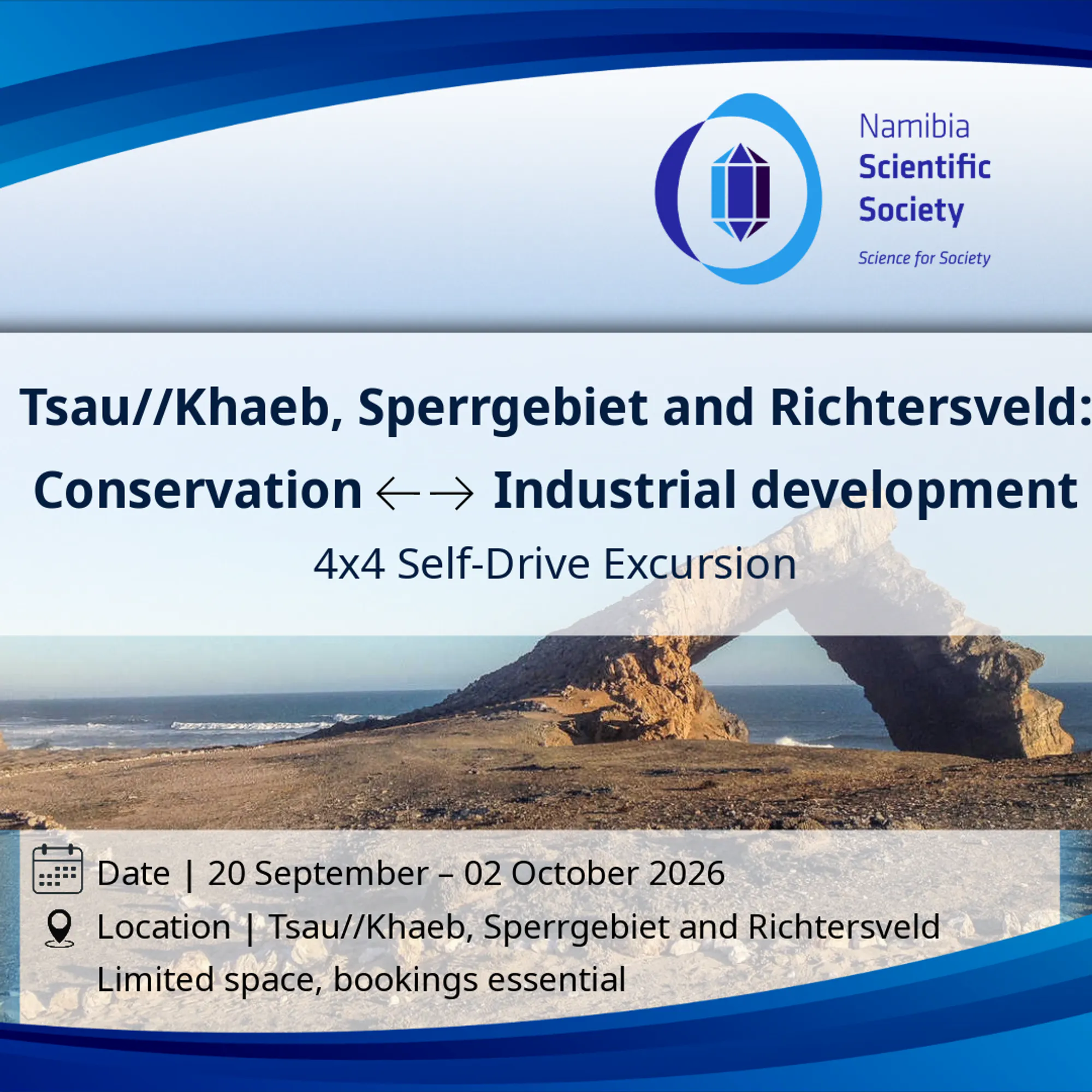
Tsau//Khaeb, Sperrgebiet and Richtersveld: Conservation ←→ Industrial development
- 20 Sep 2026 (6:00 am) to 2 Oct 2026 (12:00 pm)




20 September 2026 – 2 October 2026
With the discovery of diamonds in the early 1900’s and the ensuing scramble for ground, the Sperrgebiet was declared a restricted zone, limiting access to this vast area for more than a century.
Today, however, the landscape of opportunity is shifting. Diamond deposits are now mainly mined offshore close to the coastline, while global diamond prices have declined. As a result, large portions of land once controlled by De Beers and Namdeb have been released and are now safeguarded under Namibia’s constitutional conservation framework.
What lies ahead? Industrial projects focused on green and clean energy are emerging, and tourism is steadily increasing. Yet this growth brings inevitable traffic and human activity into a system that – ironically – remained a largely pristine ecosystem for over a century due to strict mining restrictions.
The challenge is clear: can development and tourism expand without compromising conservation and preservation? How do we ensure a balance between preserving a Karoo ecosystem influenced by fog, Summer and Winter rainfall while allowing energy (solar, wind, oil, gas) and mining development? To better understand this unique and fragile area, the Namibia Scientific Society invites specialists and interested participants to take a closer look. Key questions will be addressed with various specialists: Which sites must remain off-limits? What environmental changes are already visible? Can sustainable industry and tourism coexist in this sensitive environment?
The excursion will commence on 20 September in Lüderitz.
This will be followed by a three-day expedition through Sperrgebiet 1 to Oranjemund, before crossing into South Africa to take a closer look at and examine the impacts of mining in the Richtersveld area. During four days in Richtersveld National Park, participants will again engage with experts on local initiatives and challenges and gain insight into projects such as the Desert Botanical Garden.
Upon returning to Namibia, a visit to the Aurus Mountains - one of Namibia’s key hotspots of endemic vegetation - is envisaged before ending at the Alte Kalköfen Campsite.
It is not a secret that the weather in the south of Namibia is unforeseeable and can be extreme. There is a strong possibility of windstorms, but also a chance of extremely high or low temperatures … or even rain!
And while a detailed itinerary has been put together, the final route will have to be decided on each day.
Specialists accompanying or visited on this tour:
- Botanist / Ecologist Prof Norbert Jürgens
- Historian Prof Imre Demhardt
- Geologist Dr Roger Swart
- Chief Warden Wayne Hendley, MEFT
- HYPHEN representative
- Namdeb representative – Joyce Kajirua
- Desert Botanical Garden Founder – Pieter van Wyk, SANParks
- Section Ranger of the Richtersveld, SANParks
- Dr rer nat Ingrid Stengel
A preparatory presentation by Prof. Norbert Jürgens will be offered in Windhoek on the 17th of September, titled: Biology and Ecology of the Tsau//Khaeb and Richtersveld: Evolution and ecological processes of the Namib and the Succulent Karoo.
The outline of this tour is as follows:
20–21 September 2026 | Lüderitz
Accommodation: Lüderitz Nest Hotel
• Arrival and orientation
• Rehabilitation of mining sites and the future of Namdeb
21–24 September 2026 | Tsau //Khaeb National Park
Accommodation: Camping in the wild, Oranjemund: Oryx Guesthouse
• Travel along the coast to historic diamond mining sites
• Observation of environmental impacts and weathering
• Study of adapted flora and fauna
• Sites of rehabilitation of Namdeb
• Jasper House
24–28 September 2026 | Richtersveld National Park
Accommodation: official campsites in the Richtersveld
• Exploration of conservation and mining interactions
• Importance of the Orange River
• Engagement with conservation initiatives
• Richtersveld Desert Botanical Garden SANBI SANParks
28 September 2026–2 October 2026 | Tsau //Khaeb East, Aus and surrounding
Accommodation: Camping in the wild, Klein Aus Vista, Alte Kalköfen Campsite
• Comparison of land-use models
• Observation of endemic species
• Visit to farm Aar, home to invaluable palaeontological discoveries and a hotspot for variety of rock art traditions
NB:
Number of participants and cars (max 10 cars) is limited and will be handled on a first come first serve basis.
All participants will have to submit the following documentation to the NSS, attached to the booking form as soon as possible (no later than 28 August 2026):
- Copy of valid Passport with valid visa to travel to SA if required
- Copy of medical aid card
New rules (as from 01.07.2026) require the following documentation to be kept on hand for crossing the South African border: https://www.sars.gov.za/travellerdeclaration/
- Declaration of Foreign Registered Vehicles Used by Travellers – please find the attached flyer for your information. It is valid for 6 months, so please attend to it early.
- Online Traveller Declarations – to be submitted within 24 hours before departure into South Africa – hence in Oranjemund
Should entry to SA not be granted due to incomplete documentation, any deposit/fees paid for this trip will be forfeited.
Should entry to SA not be granted due to incomplete documentation, any deposit/fees paid for this trip will be forfeited.
Find attached the relevant documents:
To reserve your place, please complete the booking form and return it, together with the required documents, to info@namscience.com by 28 August 2026.
Please note: The opinions expressed during presentations, films or events are not necessarily endorsed by the Society.